Monday, April 22, 2013

HPL Kololo

Before leaving Kembata we used our last day in the region to make another visit to last years’ build in Kololo, as well as next year’s build locations in Mudula.  It was a productive day.  We had meetings with the school director and community members in Kololo, a meeting with the Mudula Worader head (kind of like the town’s mayor), site visits for 2013-2014 school and library builds, and a visit to the Kololo HPL Horse Powered Library program.  Along the way there was the usual coffee and local fare ceremonies, the wealth of avocados, mangos, banana, bakolo and coffee powered us along through our 13 hour day.   
Each portion of the trip merits its own blog.  I’ll put together a pithy write up on each over the coming days.  This entry will focus on another very positive visit to Kololo’s HPL. 

The Kololo community is seated comfortably on the SW side of the southern Ambakuna hill. Kololo is 13 kilometers from Mudula and around 17 from Tunto.  The region is as disconnected as any other from basic resources, governmental and most NGO support mechanisms.  Never-the-less, the hills and dense green-scapes our full of people, especially young children.  Kololo is the one institution located outside Tembaro’s city centers that provides KG education.  Children enter school without the proper preparation, and due to a maelstrom of surrounding difficulties, failure often follows. Kololo is a beacon of hope for the region, a wonderfully realized dream that provides quality early childhood education to better enable the community to flourish. 
However the schools reach is limited by the structures capacity.  There are only enough slots for a few hundred children, not nearly enough for the surrounding thousands.  More KG’s are desperately needed in the Kembata Tembaro zone as well as the rest of Ethiopias southern regions.  Presently, we here at Ethiopia Reads can only physically build two schools a year.  With adequate funding that number could jump to as high as 5 in a single year, but even that will only make a small dent into what is needed.  For the time being, we are thinking outside of the box. 

Ethiopia Reads’ HPL program brings teachers and materials to very rural and difficult to reach communities.  Currently the program has two hubs.  One in Ekodaga, and the other in Kololo.  The facilitators travel via horse or donkey upwards of 12 miles to small villages with little to no access to educational materials.  The facilitator reads Amharic children books to the participants and leads the kids through alphabet and basic number exercises.  After just a few weeks, once illiterate children are beginning to sound out words, and soon after reading along with the HPL facilitator.  The programing successfully introduces reading culture to education barren communities.  More importantly, the HPL shares the power of literacy, which soon begets an overwhelming thirst for learning.

Last Monday, Ejigu, Kahlyn, Ashu, Tamesgin and I made the trek to Tupa, Northern Ambakuna to witness the HPL session of the day.  Lagessa, the facilitator has been leading these classes now for almost three months.  He visits three different communities twice a week spending up to 3 hours with the students.  Each of the visited communities is located within very challenging terrain, yet that doesn't keep the plethora of students in each area from attending.  Lagessa is averaging around 280 students per session.  Yes, 280 students ranging from the age of 3 to teenagers.  Amazing.

Here is a collection of photos taken from my time in Tupa.   


Sunday, April 21, 2013

The Ra'ey Woman

I am very happy to share that this Saturday the Ra'ey Football club held its first open practice for its new woman's team.  While the boys team played (and won) two friendly matches against a rival Addis club,  Kahlyn and I lead the girls through a variety of drills and a four on four scrimmage.  The eight girls that showed up were enthusiastic about the opportunity to play and be coached by a couple of ferengies. The practice lasted nearly an hour and a half and culminated with the girls joining the Ra'ey boys team in happily cheering on the second half of the friendly match.  

At the match's conclusion, the coach and I had a moment to talk with a few of the girls about their first football practice experience.  Each of the four we spoke with were very happy and incredibly thankful for the chance to join the Ra'ey football club.  All told stories of having very limited access to playing the sport they loved; overt discrimination, lack of materials and field access would soon be a thing of the past. The girls are all very excited for next weeks practice,  and have vowed to find other young woman to join in on the fun. 8 is a great start, but everyone is looking forward to that number growing exponentially in the coming weeks.

Kahyln and I are proud to be a part of something so positive for the young woman of Addis Ababa.

Some of the ladies after practice with their coaches


Sun was pretty vicious


Wednesday, April 17, 2013

Fundame Completion Party

"Hulet woof ba aundt dinga" - Two birds with one stone.

Background:
In under seven months, Ethiopia Reads has constructed two schools and one library in the Kembata region of southwest Ethiopia.  On Friday April 12th, the Fundame schools completion was celebrated by villagers near and far as an example of what a community can achieve when supported and guided effectively.  286 different community members banded together to create a structure that will serve the entire population for generations. The school is beautiful today, and with regular maintenance those aesthetic qualities will persevere for decades.  

Fundame's new addition to its present 1-8, will provide greatly needed KG education for Fundame's children, as well as provide a base for further Ethiopia Reads programming in the area.  Previously, children entered first grade with little to no exposure to even the fidel (alphabet).  Consequently students quickly fall behind and  over the coming years problems dangerously snowball.  High rates of students drop out at an early age, while over 70 percent of those that continue onward are able to meet the national testing standards.  What that means, less then 5 percent of the regions students enrolled in government public schools graduate from university.  Pre KG and KG education offers an opportunity to better enable Fundame's children to succeed.   

The school is almost completely built of organic materials.  A well constructed wooden frame supports the schools walls and corrugated roofing.  Walls consist of split timbers with multiple coatings of cob and plaster on the interior and cob and cement on the exterior.  Meanwhile the flooring is created by the construction of a large cement slap sitting on top of a foundation of tightly compacted boulders.  Doors and windows are made locally by Kembatan artisans, and 100% of the organic material used in the school construction was procured within five kilometers of where the school sits.  

The Celebration:
..was a beautiful occasion, broken into numerous moments that will  resonate with participants well into the future . Nearly 120 shamegalees (village elders) traveled to to the build.  The community, lead by these village elders, each pitched in a small amount to purchase additional food and beverages for the celebration.  The community felt strongly that the project and its supporters deserved a gradios party for a significant amount of the community. Fundame is the 4th school I have built with Ethiopia reads, yet this sort of community initiative is a first for me.  Ejigu and I were both greatly moved by the communities decision, and shared our admiration following the presentation of the additional food and drink. During the program, five village elders, unprompted, used the occasion to further galvanize the community. Each spoke to different aspects of the process of bringing the project to fruition, however each returned to a central theme; the building of a stronger Fundame community. 

Through ER's unique participatory leadership, and assimilation into the community, temporary workers didn't feel the disconnect that permeates through almost all other "foreign development" work in the region.  ER invited the community into most facets of the management of the build.  We requested that offer their own advice on building the school, and how best to effectively succeed in its completion.  Village elders, community leaders and school administrators often met with Ejigu and myself to discuss concerns as well as offer constructive feedback through the entire build process.  Meanwhile the entire ER field team lead through action as well as command.  Sallamnesh, Tamesgin, myself and even Ejigu on occasion, worked alongside the Fundame community in show of solidarity.  More importantly still, is ER's efforts in providing first hand training in multiple types of organic construction.  Workers left the site not only with salary in their pocket, but also with skills that they could use to garner future employment.  Even in construction its not just about the end product, but the process that creates it.  

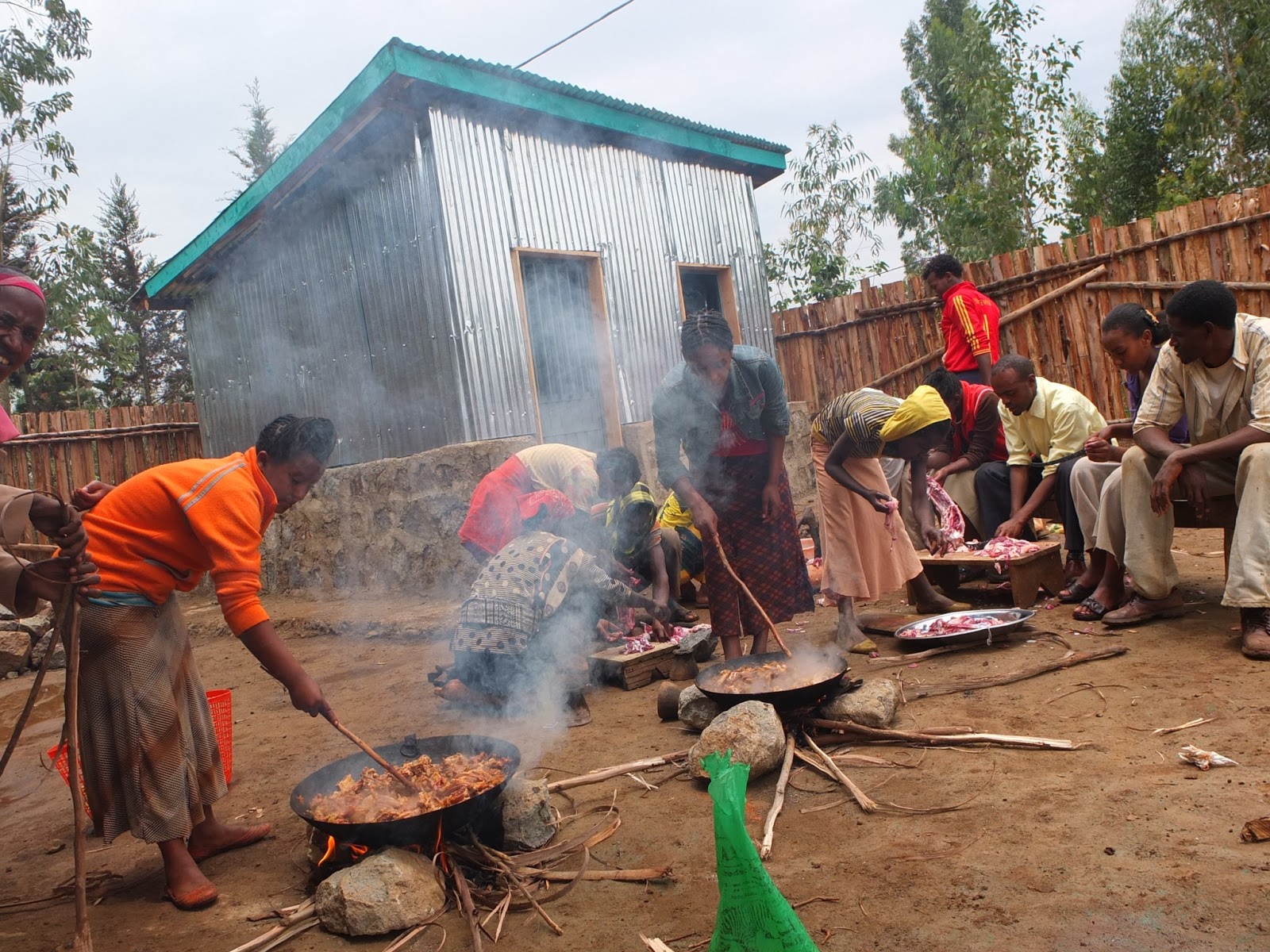
The program lasted nearly 3 hours, culminating in the devouring of tens' of kilos of freshly prepared lamb.  It was a remarkable showing of community support.  Going into the Ethiopian rainy season, Fundame's future beneficiaries and ER alike can rest assured that the school is in good hands.  A dedicated community and organization, that will work together well into the future to ensure the high quality of early child education in the area. 

Once again I want to take the time to thank the Moss family for its tireless effort to organize multiple fundraisers, and connect like minds to make this project possible.  Their love and support has gone beyond what any organization could ask of its donors, and all of us here at ER, Fundame, and Azedebo thank you deeply.

*big thanks also goes to my sis for assisting on the photos.  


Sallamnesh and I installing the door before the party kicked off
Kololo successfully entertained the kids during the pre-party setup
Jossi prepping his meat knives for butchering 
Village elders start flowing in
1 of 2 to be butchered.  Isnt this guys wreath of flowers rad.

Ejigu was asked to assist in the first slaughter
The ER and Azedebo team takes a seat and waits for the procession of village elders.  
Program begins
Ejigu talking through what else ER/ Tesfa do
One of the school administrators helped with the translations into the local language
Presentation of the construction skill training completion certificates  

The ladies ready the ingredients and the fire
Trimming the skin. Not the fat.  Thats where the flavors at.
Village elder takes time to talk about the importance of the community
assisting in the schools future admin and maintenance of the build.  He
also shared some very humbling words about the ER work team. 
A community leader takes the floor 
Ashu and I did some Q and A with those in attendance 
Everyone was enjoying themselves.
The feast is readied 

The finished product. 
Birds start swarming in looking for scraps 

Ashu was happy to assist in prep again